

Wildfire Risk Home Policy: Strengthen Your Coverage With The California FAIR Plan
California’s wildfire season grows more intense each year, and standard homeowners insurance often leaves you exposed. We at Cappuccino Insurance Agency see this gap firsthand-many policies exclude or severely limit wildfire coverage in high-risk areas.
The California FAIR Plan exists to fill this void, but it’s only part of the solution. This guide shows you how to layer FAIR Plan coverage with additional protection to truly secure your home.
Why Your Standard Policy Won’t Protect You in Wildfire Country
The Insurance Market Has Shifted Against Homeowners
California’s insurance market has fundamentally shifted. Insurers cancel and non-renew policies in high-risk zones at unprecedented rates, leaving homeowners scrambling for coverage. The California Department of Insurance documented a surge in nonrenewals as climate-driven wildfire risk outpaced traditional underwriting models. A mandatory one-year moratorium on insurance companies canceling or non-renewing residential insurance policies represents an important consumer protection law. Standard homeowners policies sold five years ago often excluded wildfire damage entirely or buried it under exclusions that made claims nearly impossible to collect. Even policies that technically cover fire damage frequently cap payouts far below what rebuilding actually costs.
Coverage Gaps That Leave You Exposed
Standard policies fail to protect you in multiple ways. Dwelling coverage maxes out far below reconstruction expenses-many homeowners discover their $500,000 limit falls short when rebuilding costs exceed $1.2 million. Personal property coverage comes with blanket limits that don’t account for high-value items like jewelry or firearms, leaving you underinsured on the things that matter most. Standard policies also omit liability coverage for wildfire-related damage you might cause to neighbors’ properties, a gap that exposes you to six-figure lawsuits. Loss of Use coverage-the benefit that pays for hotels and meals during rebuilds-typically runs 12 to 18 months, which falls drastically short when California reconstruction timelines stretch to three or four years due to permit backlogs and contractor scarcity.
The Affordability Problem Drives Impossible Choices
The real problem isn’t that insurers won’t write policies; it’s that they won’t write them at rates that reflect actual risk. About two-thirds of U.S. homes are underinsured according to the Insurance Information Institute, and California’s wildfire-prone areas skew even worse. Insurers now charge wildfire deductibles ranging from 5 to 25 percent of your home’s value, meaning a $100,000 deductible isn’t uncommon in high-risk counties. This pricing forces homeowners into an impossible choice: accept coverage gaps or abandon insurance altogether.
Why the FAIR Plan Alone Isn’t Enough
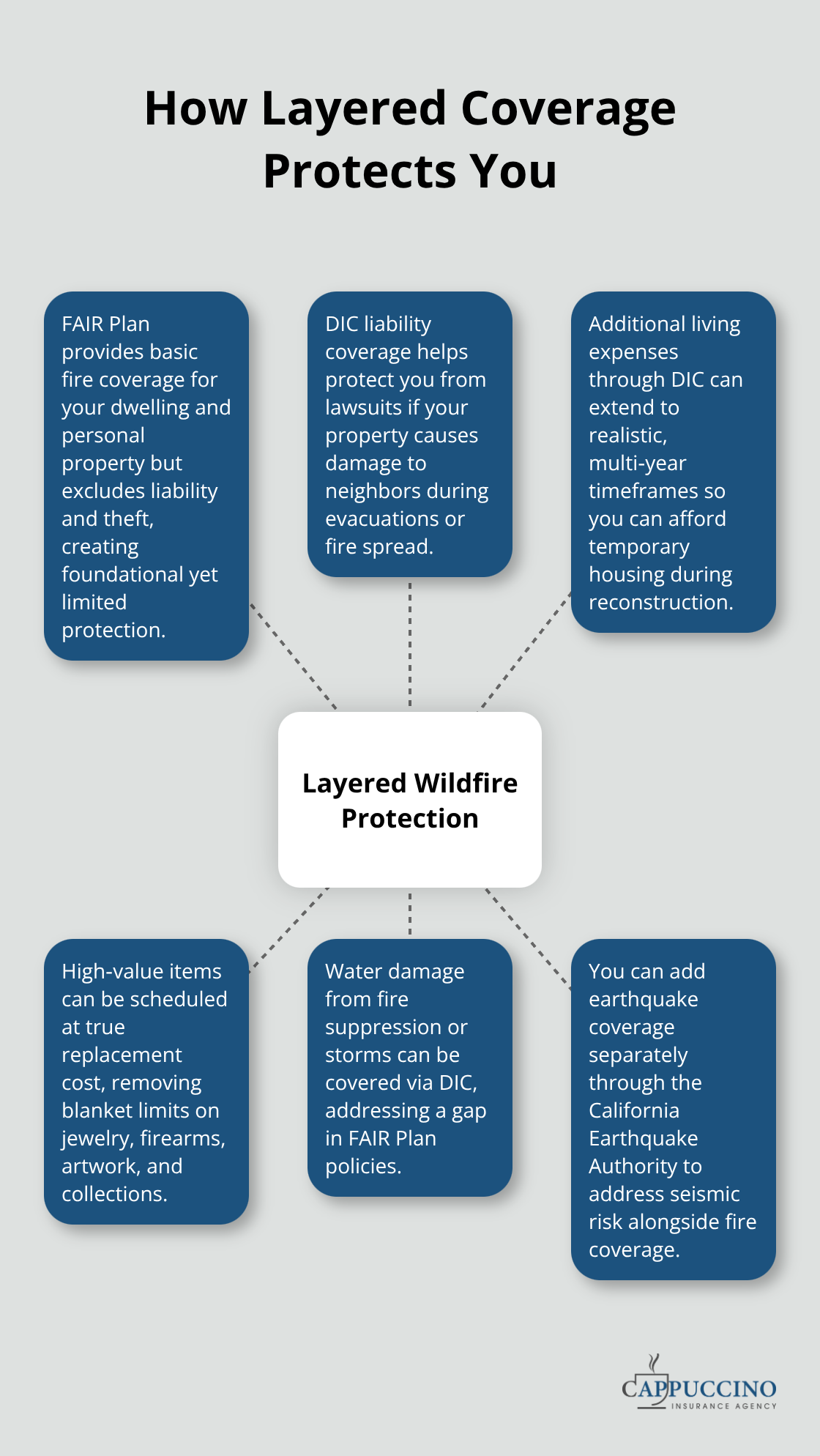
The California FAIR Plan steps in as the insurer of last resort, though FAIR Plan policies provide only basic fire protection without liability or theft coverage. However, FAIR Plan coverage alone leaves you vulnerable to the same gaps as traditional policies. A layered approach-FAIR Plan as your foundation, supplemented with additional protections-fills the holes that traditional and FAIR Plan coverage leave behind.
What the California FAIR Plan Actually Covers
Understanding the FAIR Plan’s Structure and Role
The California FAIR Plan operates as a private association controlled by insurance companies and overseen by the California Department of Insurance. It has functioned for more than 50 years as an insurer of last resort, meaning it exists specifically for homeowners and businesses that cannot obtain coverage through traditional insurers. The plan is not taxpayer-funded; instead, participating insurers manage its day-to-day operations under state regulatory oversight. As of March 2026, the FAIR Plan covered 684,388 policies statewide with total exposure reaching $750 billion, up 242 percent since September 2022. This explosive growth reflects the reality that California’s insurance market has contracted dramatically, leaving more homeowners with nowhere else to turn.
Residential and Commercial Coverage Options
If you cannot secure coverage in the voluntary market, the FAIR Plan provides dwelling coverage for owner-occupied or tenant-occupied properties with up to four units, plus personal property coverage for renters and condo owners. Commercial coverage extends to business-owned buildings including retail, manufacturing, farms, wineries, and office buildings, with individually owned habitational buildings containing five or more units also eligible. Dwelling coverage now reaches up to three million dollars per location for residential properties, while commercial coverage extends to twenty million dollars per structure, representing significant increases from previous limits. The FAIR Plan provides basic fire protection with no liability or theft coverage, meaning you remain exposed to major gaps without supplemental protection. The plan includes optional earthquake coverage through the California Earthquake Authority for residential properties and tenants’ personal property, allowing you to address seismic risk separately.
Premium Costs and Growth Trends
Written premium totaled two point zero-two billion dollars as of March 2026, up 208 percent since 2022, reflecting both the growing number of policies and rising reconstruction costs. New business during the first half of fiscal year 2026 totaled 98,677 policies, averaging 16,466 monthly, showing the relentless flow of homeowners into the plan as traditional coverage disappears. The FAIR Plan publishes quarterly statistics by county and ZIP code, allowing you to see exactly how many policies exist in your area and understand the concentration of wildfire risk where you live.
How to Apply for FAIR Plan Coverage
You cannot apply directly to the FAIR Plan without broker assistance; instead, locate a licensed broker through the FAIR Plan’s Broker Finder tool on their website or call them at 800-339-4099. A licensed broker conducts a diligent market search to confirm that traditional insurers have rejected your application. The broker will attempt to place your property with three or more private carriers first, and only when that search fails does the FAIR Plan become appropriate for your situation.
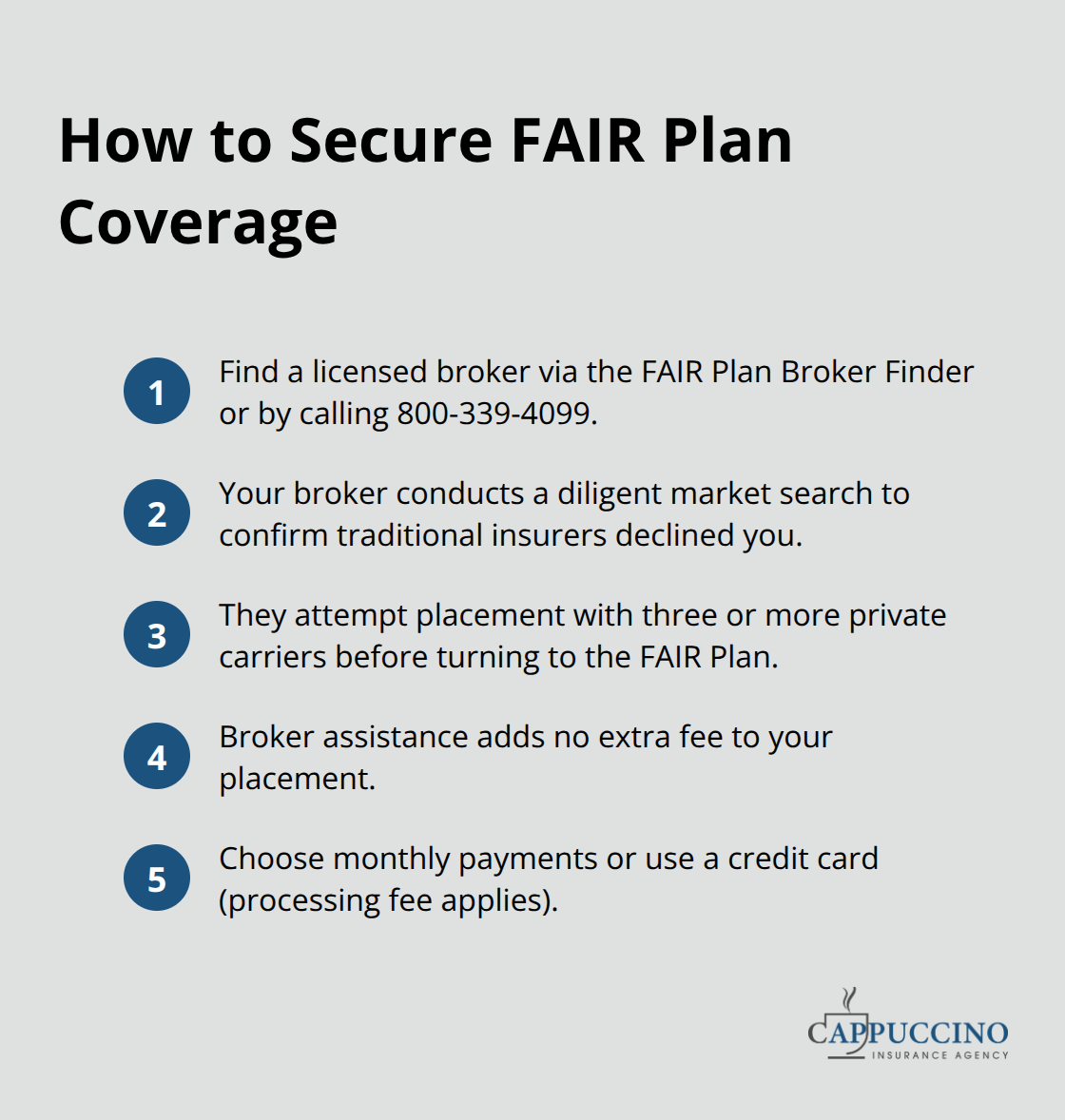
The broker’s assistance costs nothing extra, making this the only viable path to FAIR Plan coverage. Monthly payment options are now available with no extra fee, and credit card payments incur only a processing cost, giving you flexibility that didn’t exist in previous years.
Discounts and Premium Reduction Opportunities
Safer from Wildfires discounts reward homeowners who harden their properties against fire risk (clearing defensible space, upgrading roofing materials, and closing ember entry points), potentially reducing your premium meaningfully if your property qualifies. These discounts acknowledge that property owners who invest in risk reduction deserve lower rates, and they create a financial incentive to strengthen your home’s wildfire resilience. Once you secure FAIR Plan coverage, the next critical step involves understanding what gaps remain and how to fill them with additional protection that transforms basic fire coverage into comprehensive security.
How to Bridge FAIR Plan Gaps With Additional Coverage
Why FAIR Plan Coverage Falls Short
FAIR Plan coverage alone leaves you vulnerable because it excludes liability protection, theft coverage, and additional living expenses-three categories where homeowners face catastrophic financial exposure during and after wildfires. The California Department of Insurance explicitly recommends adding a Difference in Conditions policy to approximate comprehensive homeowners insurance when FAIR Plan coverage is your only option. A Difference in Conditions policy wraps around your FAIR Plan dwelling and personal property coverage to fill the specific gaps that basic fire protection leaves open. This layered approach transforms FAIR Plan coverage from a bare-bones safety net into genuine protection that covers what actually happens when wildfires threaten your home and life.
What Difference in Conditions Policies Add
Difference in Conditions policies add liability coverage that protects you if your property causes damage to neighbors during a wildfire evacuation or fire spread. They restore additional living expenses coverage to realistic levels-typically two or more years of hotel costs, meals, and temporary housing-so you can afford to relocate while reconstruction happens. High-value item coverage through DIC policies removes the blanket limits that standard and FAIR Plan policies impose on jewelry, firearms, artwork, and collections, allowing you to schedule items at their true replacement cost with full coverage.
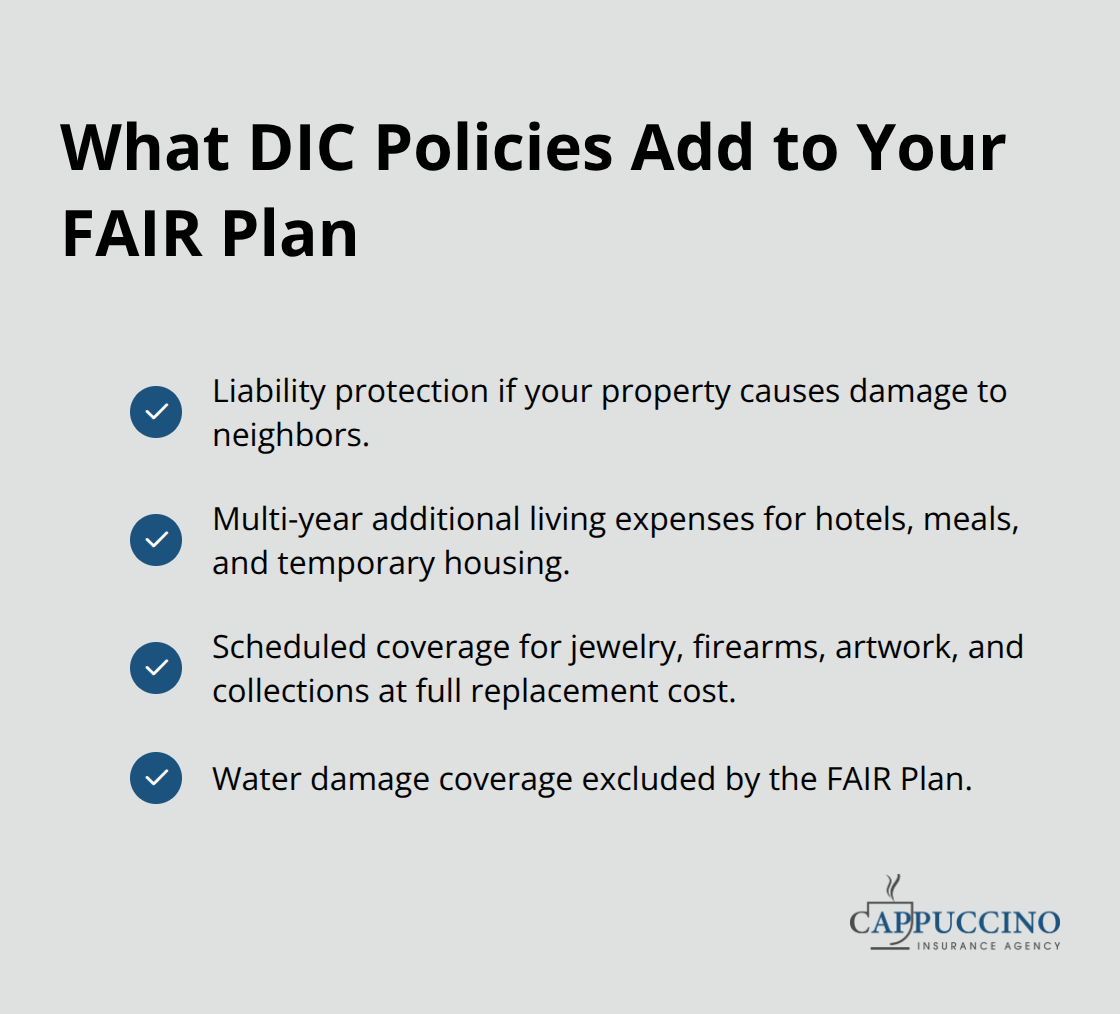
Water damage coverage becomes available through DIC because FAIR Plan policies exclude it entirely, leaving you exposed when fire suppression efforts or subsequent storms damage your interior.
How Combined Coverage Protects You
When you combine FAIR Plan dwelling coverage with a DIC policy, you achieve protection that mirrors what comprehensive homeowners insurance provides, but you access it through the only available path when private insurers have rejected your application. A homeowner in Ventura County with a $2.5 million replacement cost dwelling secured FAIR Plan coverage up to $3 million combined with a DIC policy covering liability up to $1 million and additional living expenses for 36 months. When that homeowner’s neighborhood faced evacuation during the 2023 fire season, the DIC liability coverage protected them from a neighbor’s lawsuit over property line damage, and the additional living expenses benefit covered eighteen months of temporary housing while contractors addressed permit delays. Without that DIC wrapper, the homeowner would have faced a six-figure legal judgment and depleted savings covering rental costs.
The Coverage Gap in California’s Market
The FAIR Plan data shows that as of March 2026, over 684,000 California properties depend on FAIR Plan coverage, yet most carry only basic fire protection without supplemental policies-a gap that leaves them financially exposed to the exact scenarios that trigger claims. This concentration of underinsured properties across the state reflects a market failure where homeowners lack access to the layered protection they actually need. Independent agencies that specialize in wildfire-risk properties understand how to structure FAIR Plan and DIC coverage together, because the combination requires coordination to avoid overlaps and ensure every exposure receives appropriate limits.
Final Thoughts
California’s wildfire risk home policy landscape demands a two-part strategy: FAIR Plan coverage as your foundation, layered with Difference in Conditions protection to fill the gaps that basic fire coverage leaves open. This combination transforms inadequate protection into genuine security that covers dwelling damage, liability exposure, high-value items, and living expenses during reconstruction. Over 684,000 California properties now depend on FAIR Plan coverage, yet most remain underinsured without supplemental policies.
Start by scheduling a coverage assessment with an independent agency that understands wildfire-risk properties in your area. Request a rebuilding cost estimate from a local contractor to confirm your dwelling limit actually covers reconstruction expenses, not just the inflated estimate your insurer provided years ago. Review your personal property limits and identify high-value items that need individual scheduling to receive full coverage, and confirm your additional living expenses benefit runs long enough to cover California’s extended reconstruction timelines (which frequently stretch beyond two years due to permit backlogs and contractor availability).
Working with a local agency matters because wildfire-risk properties require specialized knowledge that national carriers and online brokers simply don’t possess. Cappuccino Insurance Agency partners with multiple carriers to deliver FAIR Plan and Difference in Conditions solutions specifically designed for hard-to-place properties across California, and our team conducts free coverage assessments to identify gaps in your current protection and structures DIC policies that wrap your basic coverage into comprehensive protection.
The information provided in this blog is for general informational purposes only and does not constitute legal, financial, or insurance advice. Coverage options, terms, and availability may vary. Please consult with a licensed professional for advice specific to your situation. Artificial intelligence may have been used to generate text and images in some blog articles and may contain inaccuracies.


