

Home Policy Evaluation California: Is Your Coverage Up to Date?
Your home insurance policy isn’t a set-it-and-forget-it document. California’s rising property values, intensifying fire seasons, and unpredictable weather patterns mean your coverage from three years ago probably doesn’t protect you today.
We at Cappuccino Insurance Agency help homeowners conduct a thorough home policy evaluation in California to catch gaps before they become expensive problems. This guide walks you through exactly what to review and what most people miss.
Why Your Coverage Is Falling Behind
California homeowners face a collision of rising costs and intensifying risks that make outdated policies dangerously inadequate. The Terner Center’s analysis of California Department of Insurance data from 2019 to 2023 shows that median annual home insurance costs sit around $1,200, but this figure masks a critical reality: replacement costs have accelerated far beyond inflation. A home that cost $500,000 to rebuild in 2021 might now cost $650,000 or more due to labor shortages, material price spikes, and stricter building codes. Your dwelling limit from three years ago almost certainly underestimates what you’d actually need to rebuild today.
Building codes now drive reconstruction expenses higher
California’s building codes have tightened significantly following major fire seasons, meaning any rebuild after a loss triggers code-upgrade requirements that standard policies often cap or exclude entirely. This coverage gap forces homeowners into out-of-pocket expenses that can reach tens of thousands of dollars. When you rebuild, you must comply with current codes-not the codes that existed when your home was originally constructed. Ordinance or law coverage (also called building code upgrade coverage) protects against these escalating costs, yet most homeowners carry policies without it.
Wildfire risk has fundamentally changed your exposure
CAL FIRE data reveals that since 2015, California has experienced 15 major fires with 174 fatalities and 55,528 buildings destroyed. This isn’t historical context-it’s your current threat level. Homeowners in wildfire-distressed areas now have expanded private market options thanks to California’s Sustainable Insurance Strategy, which allows insurers to use catastrophe modeling for more accurate risk assessment rather than relying on outdated historical data. If your property sits in a high-risk fire zone, your old premium structure no longer reflects actual exposure.
Water and earthquake damage require separate policies
Unprecedented weather patterns create water damage scenarios that standard homeowners policies explicitly exclude. Flooding isn’t covered by typical policies, and FEMA’s National Flood Insurance Program caps structure coverage at $250,000 and contents at $100,000 for single-family homes. Earthquake coverage, essential in California, also requires separate purchase through the California Earthquake Authority. Your three-year-old policy almost certainly lacks adequate provisions for these perils.
Home improvements silently create coverage shortfalls
Home improvements and renovations increase replacement value but don’t automatically update your coverage limits. Adding a second story, finishing a basement, or installing a pool all raise what it would cost to rebuild your home. Many homeowners discover this gap only after a claim denial, when the insurer refuses to pay for reconstruction costs that exceed the dwelling limit. Your next step involves a detailed assessment of what your home would actually cost to rebuild today and whether your current limits match that figure.
What You Actually Need to Review Right Now
Start by calculating your home’s true replacement cost, not its market value. The California Department of Insurance emphasizes this distinction because they are fundamentally different numbers. Your home’s market value reflects what buyers would pay today; replacement cost reflects what it would actually cost to rebuild your exact home with current materials, labor, and code requirements. Contact local contractors or use the California Department of Insurance Home Inventory Guide to document your home’s square footage, construction type, and special features. Then multiply that by your area’s current per-square-foot construction cost, which varies dramatically across California-coastal areas and fire-prone regions see substantially higher rates than inland communities. Most homeowners underestimate this figure by 20 to 40 percent.

Your dwelling limit must match today’s reconstruction expenses
Your dwelling limit should match or slightly exceed your replacement cost calculation. If your policy shows a dwelling limit of $400,000 but your home would actually cost $550,000 to rebuild today, you’re carrying a gap that will hit you directly after a claim. Building codes now drive reconstruction expenses higher because any rebuild after a loss triggers code-upgrade requirements that standard policies often cap or exclude entirely. This coverage gap forces homeowners into out-of-pocket expenses that can reach tens of thousands of dollars. When you rebuild, you must comply with current codes-not the codes that existed when your home was originally constructed. Ordinance or law coverage protects against these escalating costs, yet most homeowners carry policies without it.
Your deductible must match your actual emergency fund
A low deductible feels safer but inflates your premium unnecessarily if you have savings available. The California Department of Insurance data shows that typical homeowners spend about 1 percent of income on insurance, but this varies by income level-households earning under $66,000 annually spend closer to 3 percent of income on coverage. If you fall into that bracket, raising your deductible from $500 to $1,500 might save 15 to 20 percent on your annual premium, money you can redirect elsewhere. However, this strategy only works if you actually have $1,500 in liquid savings set aside specifically for that deductible. Otherwise, a claim becomes a financial disaster. High-income households with six months of emergency reserves can comfortably absorb higher deductibles. Lower-income households should prioritize lower deductibles even if premiums cost more, because the alternative is uninsured loss exposure.
Wildfire zones demand specialized coverage you probably don’t have
If your property sits in a wildfire-distressed area, your policy needs explicit protection beyond standard dwelling coverage. California’s Sustainable Insurance Strategy now allows private insurers to use catastrophe modeling to price risk more accurately, which means coverage options have expanded-but only if you actively seek them out. Difference-in-Conditions policies wrap around basic coverage to address gaps that standard homeowners policies leave exposed in high-risk fire zones. These policies cover specific perils that your primary policy excludes or limits, and they’re essential if you live in one of the zones where CAL FIRE documented the 55,528 buildings destroyed since 2015.
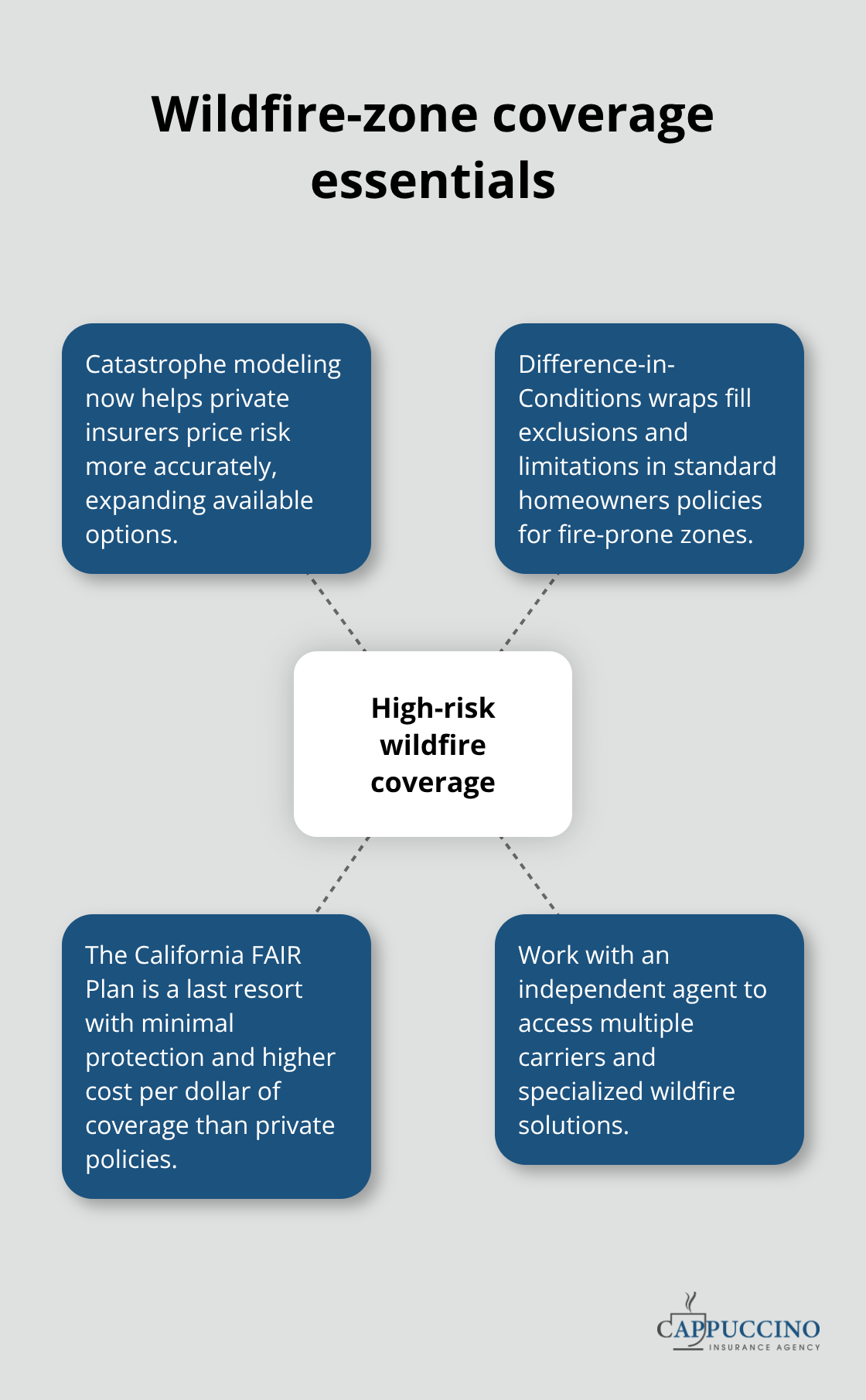
The California FAIR Plan provides basic fire coverage as a last resort when private market options disappear, but it offers minimal protection and costs substantially more per dollar of coverage than private policies.
Earthquake and flood coverage require separate action
Earthquake coverage through the California Earthquake Authority and flood insurance through FEMA’s National Flood Insurance Program remain separate purchases, but homeowners in high-risk areas need both to avoid catastrophic uninsured loss. Unprecedented weather patterns create water damage scenarios that standard homeowners policies explicitly exclude. Flooding isn’t covered by typical policies, and FEMA’s National Flood Insurance Program caps structure coverage at $250,000 and contents at $100,000 for single-family homes.
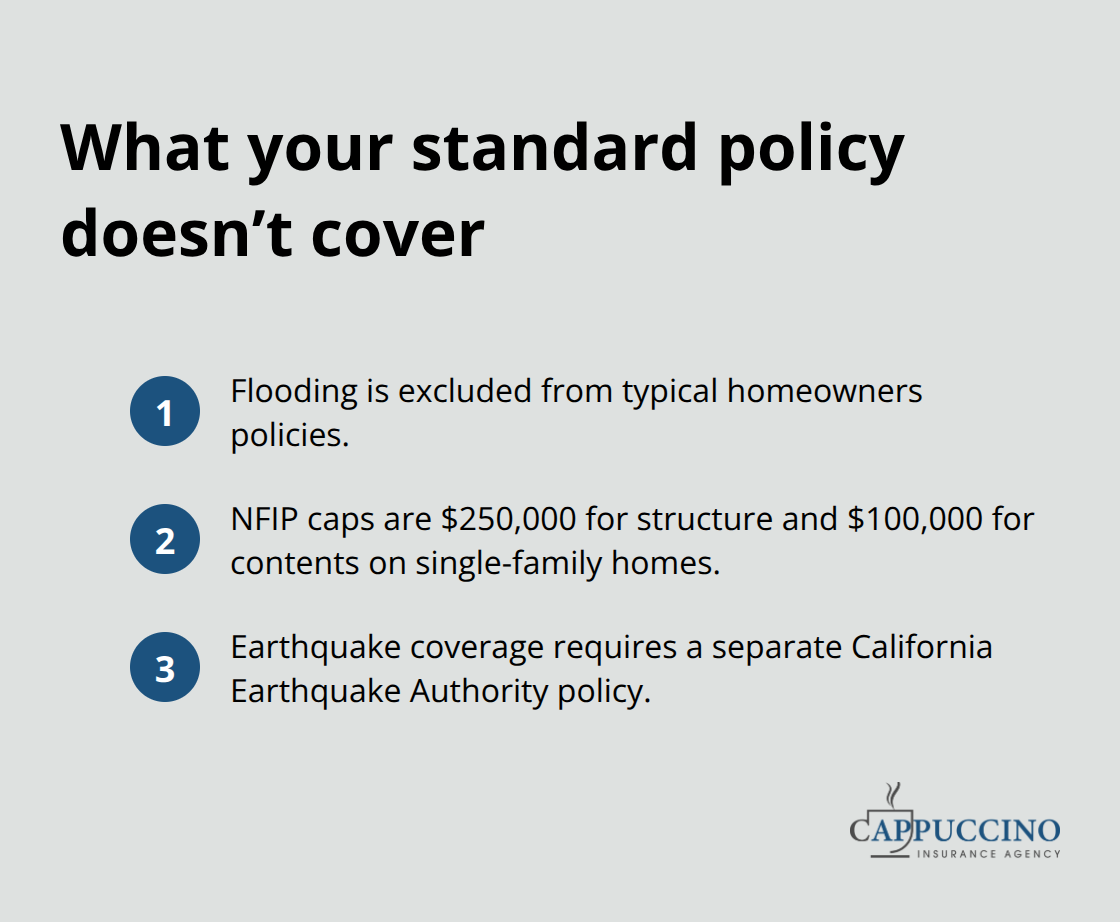
Earthquake coverage, essential in California, also requires separate purchase through the California Earthquake Authority. Your three-year-old policy almost certainly lacks adequate provisions for these perils. If you’re currently in the FAIR Plan or considering it, contact an independent agent who works with multiple carriers to find private market solutions for wildfire-risk properties before FAIR Plan placement becomes necessary. The gaps you’ve identified in your current coverage-whether they involve dwelling limits, building code protection, wildfire-specific endorsements, or missing earthquake and flood coverage-point toward a comprehensive reassessment that goes beyond a simple policy review.
The Three Coverage Mistakes That Cost California Homeowners Thousands
Most California homeowners discover their coverage gaps only after a loss, when the insurance company denies a claim or pays far less than expected. The California Department of Insurance data from 2019 to 2023 shows that underinsurance remains the single most expensive mistake homeowners make, yet it’s entirely preventable with a straightforward policy review.
Underinsurance on dwelling coverage creates massive financial exposure
Underinsurance on dwelling coverage happens because homeowners base their limits on outdated replacement costs or, worse, on their home’s market value rather than rebuild expenses. A home worth $600,000 on today’s market might cost $750,000 to rebuild due to labor shortages, material inflation, and mandatory code upgrades. If your policy carries a $500,000 dwelling limit, you absorb the $250,000 gap directly out of pocket after a total loss. The California Department of Insurance emphasizes that replacement cost and market value are fundamentally different calculations, and confusing them creates immediate exposure.
Most homeowners fail to account for ordinance or law coverage, which protects against the code-upgrade expenses that accompany any rebuild. Building codes in California have tightened substantially following major fire seasons, meaning reconstruction now triggers compliance requirements for earthquake resistance, fire-resistant materials, and updated electrical systems. These upgrades can easily add $50,000 to $100,000 to your rebuild bill, and standard policies either exclude this coverage entirely or cap it at levels far below actual costs.
Difference-in-conditions policies fill gaps in high-risk fire zones
The second major gap involves difference-in-conditions policies, which most homeowners have never heard of despite living in high-risk areas where they’re absolutely necessary. If you live in a wildfire-distressed zone and your primary policy carries exclusions or limitations on fire damage, a difference-in-conditions wrap fills those specific gaps by covering perils your main policy doesn’t adequately address. These policies exist precisely because standard homeowners insurance becomes restrictive in high-risk fire zones, and the California FAIR Plan offers only minimal protection at premium rates substantially higher than private market alternatives.
Independent agents who work with multiple carriers can layer difference-in-conditions coverage on top of primary policies for hard-to-place properties across California’s fire zones, ensuring clients don’t face coverage surprises when disaster strikes.
Earthquake and water damage require separate policies you likely lack
The third critical gap involves earthquake and water damage, which remain entirely separate from standard homeowners policies and require deliberate action to address. The California Earthquake Authority provides earthquake coverage as a separate purchase, and FEMA’s National Flood Insurance Program caps structure coverage at $250,000 for single-family homes. If your property sits in a flood zone or an earthquake-prone area (which describes most of California), lacking these policies means accepting uninsured loss exposure that could exceed $300,000 or more.
Water damage from unprecedented weather patterns creates scenarios standard policies explicitly exclude, and homeowners who assume their coverage extends to flooding or seismic events face devastating financial consequences. Contact FEMA’s National Flood Insurance Program Referral Center at 1-888-379-9531 or visit floodsmart.gov to explore flood coverage options and eligibility for your specific property.
Final Thoughts
Your home policy evaluation in California protects your investment because reconstruction costs and fire risk don’t remain static. The coverage gaps we’ve outlined-underinsurance on dwelling limits, missing ordinance protection, absent earthquake and flood coverage, and inadequate wildfire-zone defenses-compound every year your policy stays unchanged. California’s accelerating reconstruction costs, intensifying fire seasons, and evolving building codes mean your coverage from last year already falls short of what you actually need.
We at Cappuccino Insurance Agency work with homeowners across California to identify these gaps before they become financial disasters. Our free assessments examine your dwelling limits against current replacement costs, verify your deductible matches your emergency fund, and confirm you’re not carrying dangerous gaps in earthquake or flood protection. As an independent agency, we access multiple carriers and specialty solutions like difference-in-conditions wraps for hard-to-place wildfire properties, ensuring your coverage evolves with your property and circumstances.
Contact Cappuccino Insurance Agency to schedule your free home policy evaluation in California. Local expertise combined with access to multiple carriers means you get coverage that actually protects your home and pricing that reflects your specific situation, not generic rates that ignore wildfire zones and code-driven reconstruction expenses.
The information provided in this blog is for general informational purposes only and does not constitute legal, financial, or insurance advice. Coverage options, terms, and availability may vary. Please consult with a licensed professional for advice specific to your situation. Artificial intelligence may have been used to generate text and images in some blog articles and may contain inaccuracies.


