
Apartment Building Premiums California: Understand Costs And Coverage
Apartment building premiums in California have become increasingly complex, shaped by wildfire exposure, building characteristics, and tenant factors that directly impact your bottom line.
We at Cappuccino Insurance Agency help property owners navigate these costs by breaking down what actually drives your rates and how to reduce them without sacrificing protection.
What Drives Your California Apartment Building Premiums
Wildfire Risk Reshapes Your Insurance Costs
Wildfire risk dominates California apartment insurance pricing more than any other factor. Wildfire risk in California creates significant cost pressures as climate-linked disasters worsen the state’s housing shortage and affordability crisis. Location determines everything: properties in high-risk wildfire zones face substantially elevated premiums compared to identical buildings outside these areas.
Underwriters price in expected future losses from longer fire seasons and more intense burns. If your property sits within a defensible space zone or near previous burn areas, carriers will scrutinize roof condition, vegetation clearance, and building materials closely. Upgrading to Class A fire-rated roofing reduces your premium by 5 to 10 percent, making it one of the most cost-effective improvements available.
Building Age and Construction Type Set Your Rate Tier
Building age and construction type create the second major pricing tier. A post-2000 masonry building in standard risk areas runs $250 to $500 per unit annually, while a pre-1980 frame building costs $700 to $1,500 per unit-sometimes more if previous claims exist. Carriers charge significantly higher rates for older plumbing (polybutylene pipes), outdated electrical panels (Zinsco, Stab-Lok, Federal Pacific), and aging HVAC systems because these systems generate more claims.
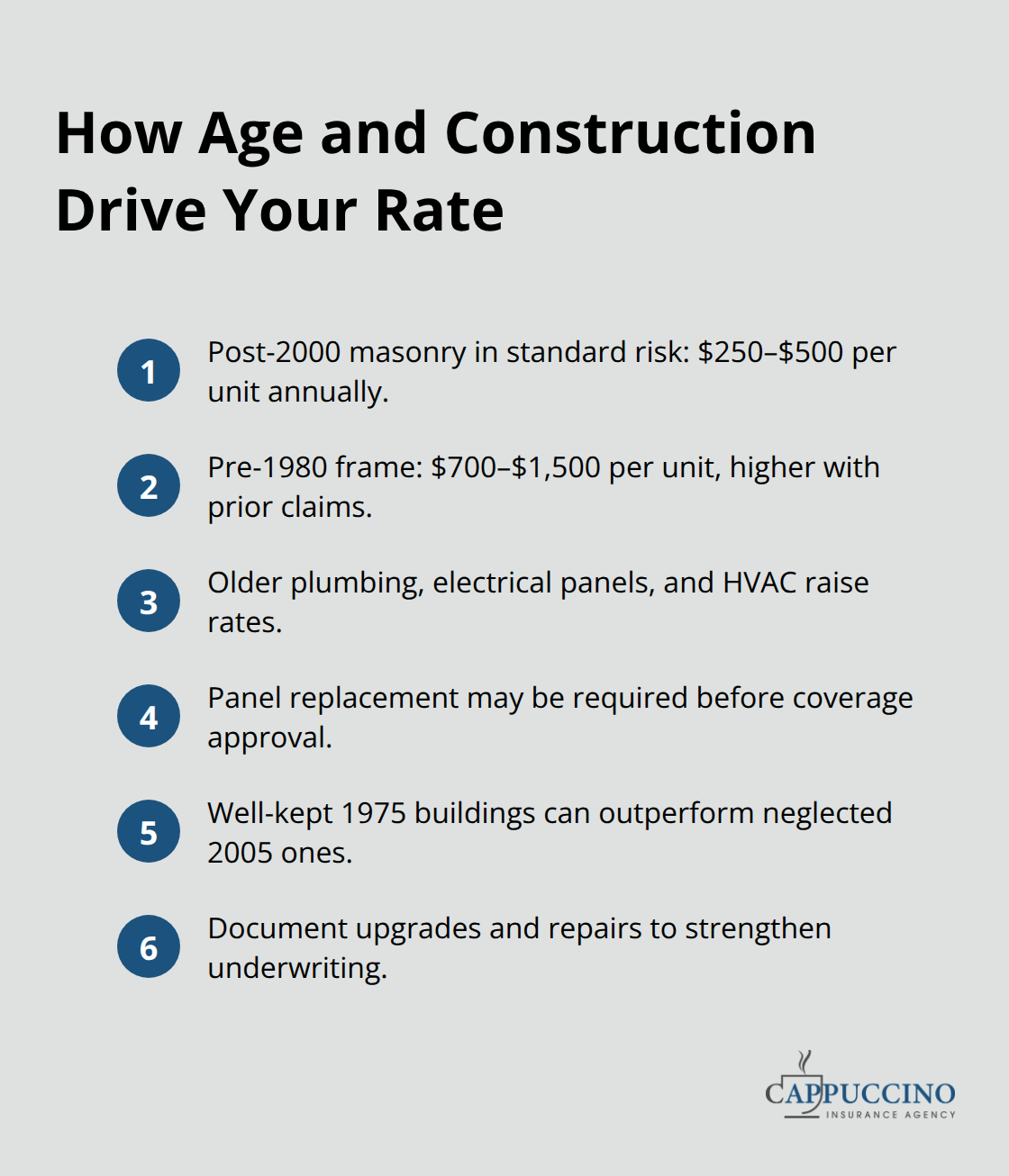
Replacing an electrical panel often becomes mandatory before coverage is approved, requiring upfront capital but unlocking better rates long-term. Maintenance history matters as much as age: a well-maintained 1975 building outperforms a neglected 2005 building in underwriting. Documentation of upgrades and repairs strengthens your position with underwriters and can influence your final quote.
Tenant Profile and Occupancy Patterns Impact Your Rate
Your tenant profile and occupancy patterns influence rates significantly. Student housing or short-term rental properties carry higher premiums due to increased turnover and claim frequency. A building with 20 units occupied by long-term working families costs less than a 20-unit property with transient tenants or corporate housing arrangements.
Five-unit properties typically cost $2,000 to $5,000 annually for newer suburban buildings but can double or triple for older urban properties. Four-unit buildings sometimes qualify for residential dwelling-fire policies, which may offer lower rates than commercial forms, making the 4-unit threshold strategically important for some owners. Understanding these distinctions helps you anticipate your costs and plan accordingly.
The combination of location, building condition, and tenant stability creates your premium foundation. Each factor compounds the others, which is why two seemingly similar properties can have vastly different rates. Your next step involves understanding which coverage types actually protect your investment and how they affect your total cost.
What Coverage Actually Protects Your Investment
Property Damage Coverage Sets Your Financial Foundation
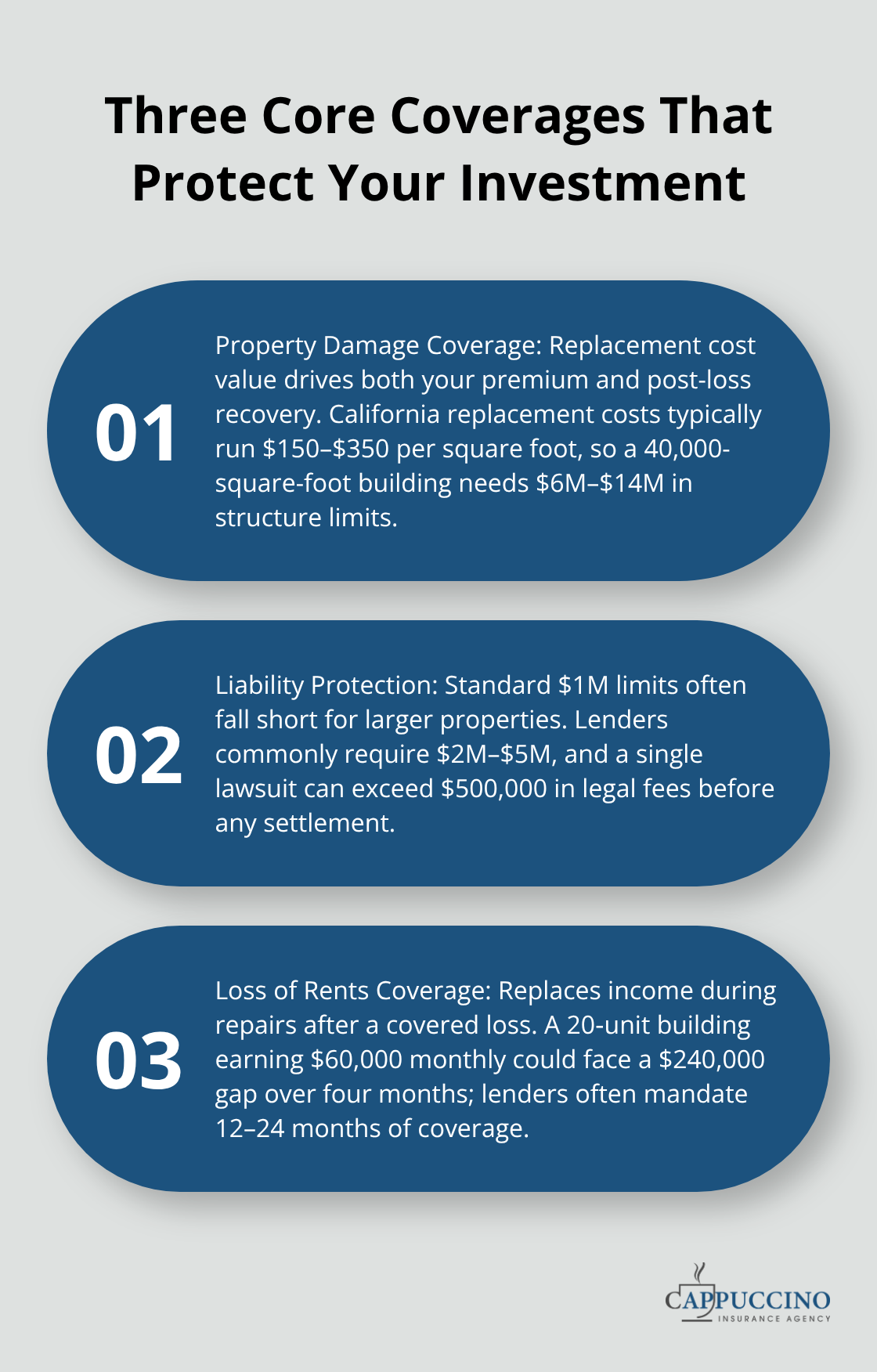
Property damage coverage forms the foundation of your apartment building protection, and the replacement cost value you select directly impacts both your premium and your financial security after a loss. The National Association of Insurance Commissioners emphasizes that underinsuring on replacement cost creates a dangerous gap between what you’ll receive and what reconstruction actually costs. In 2026, California replacement costs typically run $150 to $350 per square foot depending on construction type and location, meaning a 40,000-square-foot building needs a total insured value between $6 million and $14 million just for the structure.
If you underestimate this figure, insurers apply coinsurance penalties that reduce claim payouts proportionally-a common mistake that costs owners tens of thousands after major events. Automatic inflation adjustments cost 2 to 5 percent more annually but prevent the costly discovery at claim time that your $10 million property limit now covers only $8 million in today’s replacement costs.
Liability Protection Shields You From Legal Exposure
Liability protection serves as your legal shield when tenant injuries or property damage claims arise, and California’s broad fair housing environment means litigation costs escalate quickly. Standard general liability limits of $1 million per occurrence often prove insufficient for larger properties; lenders typically require $2 million to $5 million depending on unit count and property value. A single bodily injury lawsuit in California can exceed $500,000 in legal fees alone before any settlement, making robust liability coverage non-negotiable rather than optional.
Your liability limits must scale with your property size and exposure. Underestimating these limits leaves you personally liable for amounts exceeding your policy cap, which can threaten your entire asset base.
Loss of Rents Coverage Protects Your Cash Flow
Loss of rents coverage protects your cash flow during the weeks or months your building sits vacant after fire, water damage, or other covered perils-a protection that separates surviving owners from those facing financial collapse. If your 20-unit building generates $60,000 monthly in rental income and a major loss forces evacuation for four months, you face a $240,000 revenue gap while mortgage, property taxes, and maintenance obligations continue unchanged.
Lenders mandate 12 to 24 months of lost rents coverage as a condition of financing, reflecting their understanding that cash flow interruption poses as much risk as physical damage. Calculate your lost rents coverage by multiplying your monthly rental revenue by the number of months needed to repair and re-occupy your building-typically six to twelve months for fire damage in California’s current construction environment where labor and materials remain constrained.
Annual Coverage Reviews Prevent Silent Erosion
Many owners bundle these three coverage types without reviewing actual limits annually, allowing inflation to erode protection silently year after year. Your coverage architecture determines whether a major loss becomes a setback or a catastrophe, which is why understanding how these pieces work together matters far more than selecting them once and forgetting them.
The specific limits you carry today may not match your actual exposure tomorrow. Your next step involves identifying which cost-reduction strategies work without compromising the protection you’ve just built.
Reduce Your Premiums Without Sacrificing Protection
Lowering your apartment building insurance costs requires strategic action, not just shopping around. The most effective cost reductions come from three concrete actions that underwriters reward with measurable rate cuts.
Bundle Multiple Policies for Immediate Savings
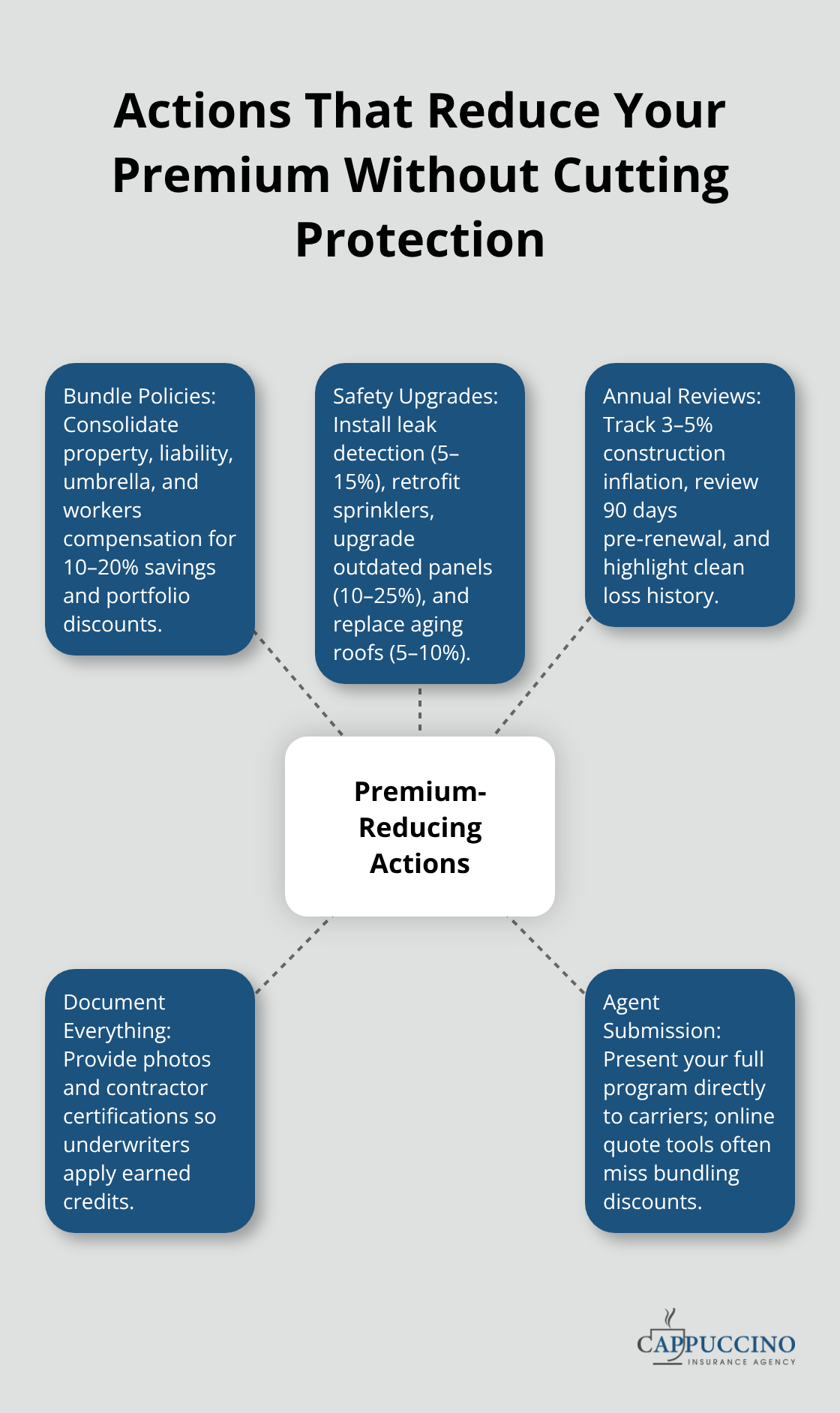
Consolidating your apartment building policy with other commercial lines-general liability, umbrella coverage, and workers compensation-typically saves 10 to 20 percent across your total premium according to industry data from the National Association of Insurance Commissioners. If you carry separate policies with different carriers, you likely leave 5 to 15 percent on the table. When you consolidate with one carrier, underwriters apply portfolio discounts that recognize you as a more stable account. A 50-unit building paying $80,000 for standalone property coverage and $25,000 for separate liability might consolidate to $85,000 total through bundling-an immediate $20,000 annual savings.
The key involves presenting all your coverage needs simultaneously to carriers so they can apply their full discount ladder. Online quote tools won’t capture these bundling advantages; you need direct carrier submission through an agent who understands which insurers offer the deepest multi-line discounts in California’s constrained market.
Install Safety Upgrades That Carriers Reward
Water-leak detection systems installed on your main water lines generate 5 to 15 percent premium credits because they catch pipe failures before catastrophic damage occurs. Sprinkler system retrofits with central monitoring provide similar credits, particularly in older buildings where fire risk pricing runs high. If your building has an outdated electrical panel-Zinsco, Stab-Lok, or Federal Pacific models-upgrading to modern equipment costs $3,000 to $8,000 but unlocks rate reductions of 10 to 25 percent that typically pay for the upgrade within three years.
A roof replacement within the last five years reduces your property premium by 5 to 10 percent because newer roofs eliminate water damage claims. Document every upgrade with photos and contractor certifications; underwriters need this evidence to apply the credits you’ve earned. Many owners skip this documentation step and never receive the rate reductions their improvements merit.
Schedule Annual Coverage Reviews Before Renewal
Your replacement cost value should increase 3 to 5 percent annually to track California’s construction inflation, yet many owners lock in the same limit for five years straight. When renewal arrives, underwriters recalculate your total insured value against current construction costs and often discover significant underinsurance-triggering rate increases to adjust for the gap. Schedule a review 90 days before renewal to gather updated replacement cost estimates, document completed repairs, and present a clean loss history to carriers.
If your building has gone three years without claims, explicitly highlight this to underwriters; a clean record qualifies you for better rates than your renewal quote initially reflects. Properties with documented maintenance records and recent upgrades (roof work, electrical updates, plumbing replacements) consistently receive more favorable renewal terms than those with sparse documentation, even when the underlying building condition is identical.
Final Thoughts
Apartment building premiums in California reflect three interconnected realities: wildfire exposure that dominates pricing across the state, building characteristics that determine your rate tier, and tenant stability that influences claim frequency. Wildfire risk alone multiplies your costs by two to five times compared to identical properties outside high-risk zones, while pre-1980 frame buildings cost three times more than post-2000 masonry structures. Tenant profile and occupancy patterns compound these factors, making student housing or short-term rentals substantially more expensive than long-term residential properties.
Securing better coverage and pricing requires concrete action rather than passive acceptance of renewal quotes. Consolidate your property, liability, and umbrella policies with a single carrier to capture bundling discounts worth 10 to 20 percent of your total premium. Invest in documented safety upgrades like water-leak detection systems, sprinkler retrofits, or electrical panel replacements that generate measurable rate reductions from underwriters.
We at Cappuccino Insurance Agency help property owners navigate apartment building premiums California owners face by partnering with multiple carriers to deliver specialized solutions for wildfire-risk properties and conducting free coverage assessments that identify rate reduction opportunities specific to your building. Contact us today to secure the protection and pricing your property actually deserves.
The information provided in this blog is for general informational purposes only and does not constitute legal, financial, or insurance advice. Coverage options, terms, and availability may vary. Please consult with a licensed professional for advice specific to your situation. Artificial intelligence may have been used to generate text and images in some blog articles and may contain inaccuracies.


