Auto Insurance Discounts California: Maximize Your Savings

California drivers overpay for auto insurance every single year. Most people stick with their current policy without realizing they’re leaving hundreds of dollars on the table through unclaimed discounts.

At Cappuccino Insurance Agency, we’ve helped countless drivers find auto insurance discounts in California that actually fit their situation. This guide shows you exactly which discounts exist and how to qualify for them.

Which Discounts Actually Save You Money in California

Safe Driver Discounts: The High Bar for Qualification

Safe driver discounts cut your premium by up to 22% according to Insurify’s data, but this discount only works if you actually qualify under California’s definition. California considers you a good driver if you have no more than one at-fault property damage accident or one moving violation point in the past three years, plus zero at-fault accidents involving bodily injury or death. One speeding ticket or minor fender-bender disqualifies you immediately. This is why safe driver discounts feel out of reach for many California drivers-the bar is genuinely high.

Chart showing maximum savings: Safe driver up to 22%, multi-policy bundling up to 25%, and low-mileage/telematics up to 30% in California. - auto insurance discounts California

The state’s minimum coverage jumped to 30,000/60,000/15,000 on January 1, 2025, which means your liability costs increased whether you qualified for discounts or not. If you do have a clean record, this discount stacks with others, so claim it.

Multi-Policy Bundling: The Most Actionable Discount

Multi-policy bundling delivers real savings that range from 7% to 25% depending on your insurer. Bundling auto with homeowners, renters, or condo policies typically produces larger overall savings than buying policies separately.

The California average for full-coverage auto insurance sits around $190 per month according to Insurify data, while liability-only averages $92 per month. Bundling could reduce your combined home-and-auto cost by hundreds of dollars annually, which makes this the single most actionable discount available.

Low-Mileage and Telematics Discounts: Privacy Versus Savings

Low-mileage and usage-based telematics discounts range from 10% to 30%, but these require different approaches. Low-mileage discounts apply if you drive significantly fewer miles than average, though eligibility thresholds vary by insurer. Telematics programs install monitoring devices or apps that track your actual driving behavior-acceleration, braking, time of day, speed.

Now that you understand which discounts actually move the needle, the next step involves qualifying for them-and that requires a different strategy for each discount type.

How to Qualify for These Discounts

Safe Driver Discounts: The Three-Year Reset

Safe driver discounts require perfection for three years straight. One speeding ticket or fender-bender erases your eligibility entirely. If you’ve already lost this discount due to a minor violation, the fastest path back is waiting. Your driving record resets after three years, so if you received a ticket in March 2023, you regain eligibility in March 2026.

This all-or-nothing qualification frustrates many California drivers. The realistic approach involves acknowledging whether you actually qualify right now rather than hoping your insurer overlooks a violation. If you don’t qualify, focus your energy on multi-policy bundling instead, which requires zero driving perfection.

Multi-Policy Bundling: The Easiest Path to Savings

Multi-policy bundling works differently because it depends entirely on what you already own, not your driving behavior. If you own a home, rent an apartment, or carry life insurance, you’re already qualified. The mechanics are straightforward: call your current homeowners or renters insurer and ask what auto bundle discount they offer, then compare that against quotes from other carriers who bundle.

California drivers who bundle typically save between 7% and 25% on their combined premium, according to data from the Insurance Information Institute. The action step here is concrete-spend one hour getting three bundle quotes and compare the total annual cost for home plus auto together, not separately. Many drivers compare auto quotes alone and miss the bigger savings hiding in bundled packages.

Annual Policy Reviews: Catching Missed Discounts

Your situation changes constantly throughout the year. You might have paid off your mortgage, qualified for a good student discount through a child, or switched to remote work and now drive fewer miles. Insurers rarely proactively adjust your premium downward when these changes happen-you must initiate the conversation.

Set a calendar reminder for your policy renewal date each year and request a fresh quote before your renewal goes through. This 30-minute task typically surfaces 2-4 new discounts you weren’t using before. California drivers who review annually save an average of $200-$400 per year simply because they caught discounts their previous quote missed.

Moving Forward with Strategic Comparisons

Once you’ve identified which discounts apply to your specific situation, the next step involves comparing how different carriers price those discounts. Not all insurers value the same discounts equally, which means your best rate depends on finding the carrier whose pricing aligns with your profile.

Strategic Policy Choices That Actually Lower Your Premium

Compare Bundle Quotes Across Multiple Carriers

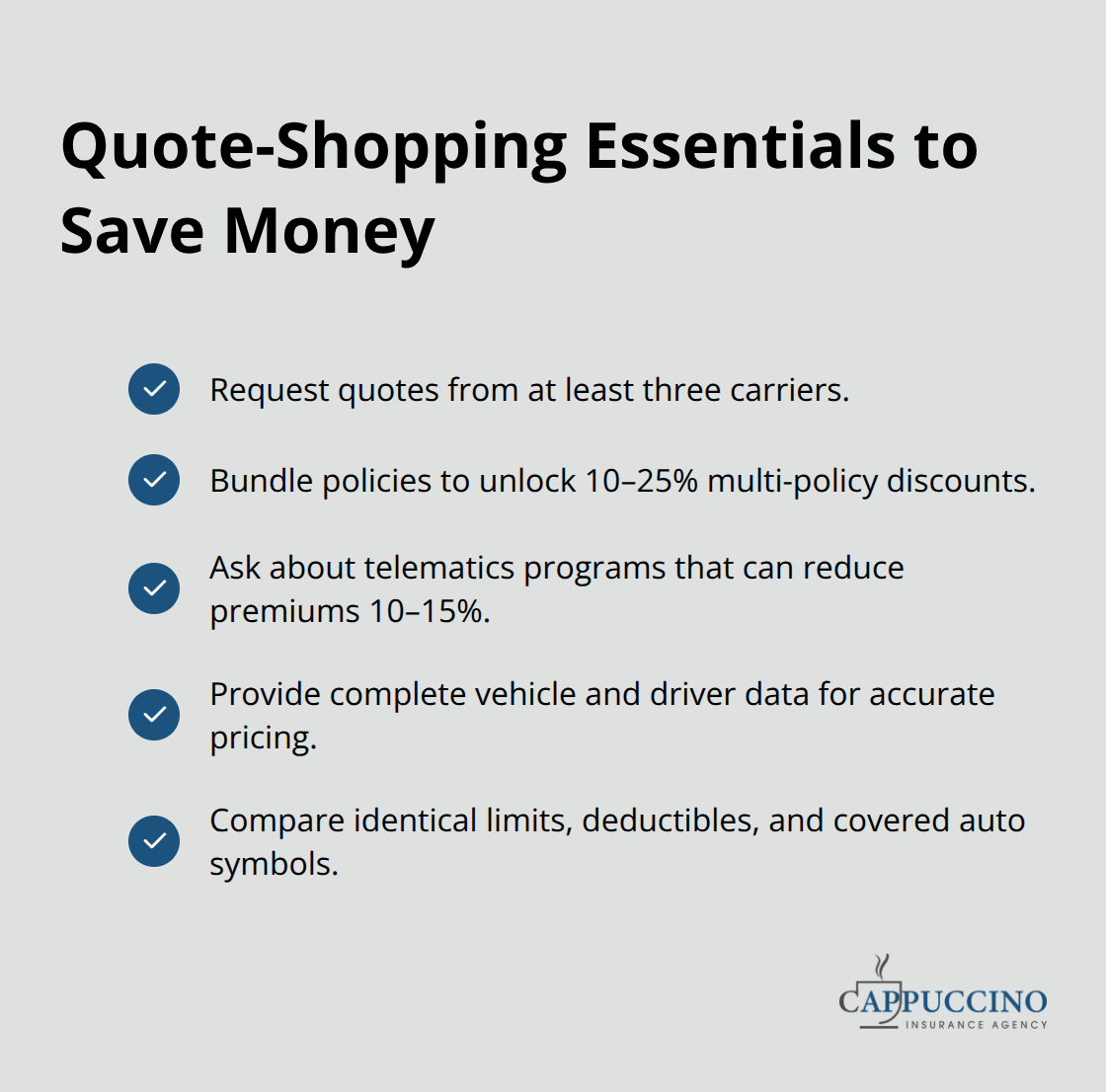
Bundling home and auto insurance remains the fastest way to reduce your overall insurance costs, but the execution matters far more than the intention. When you call your current homeowners insurer to add auto coverage, you’ll typically see a bundle discount between 7% and 25% depending on the carrier and your location. However, this approach often leaves money on the table because you anchor to your existing insurer’s pricing.

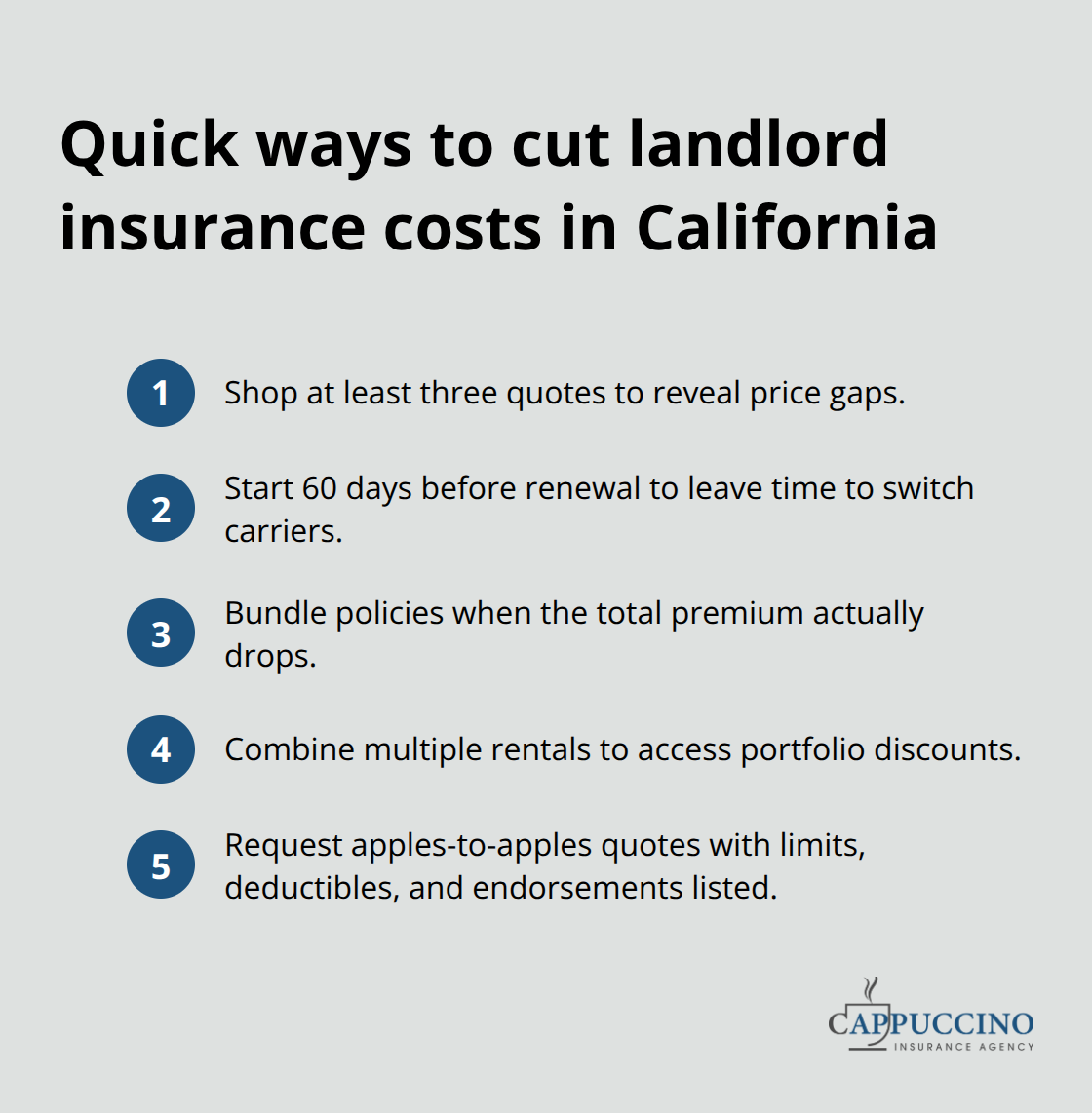
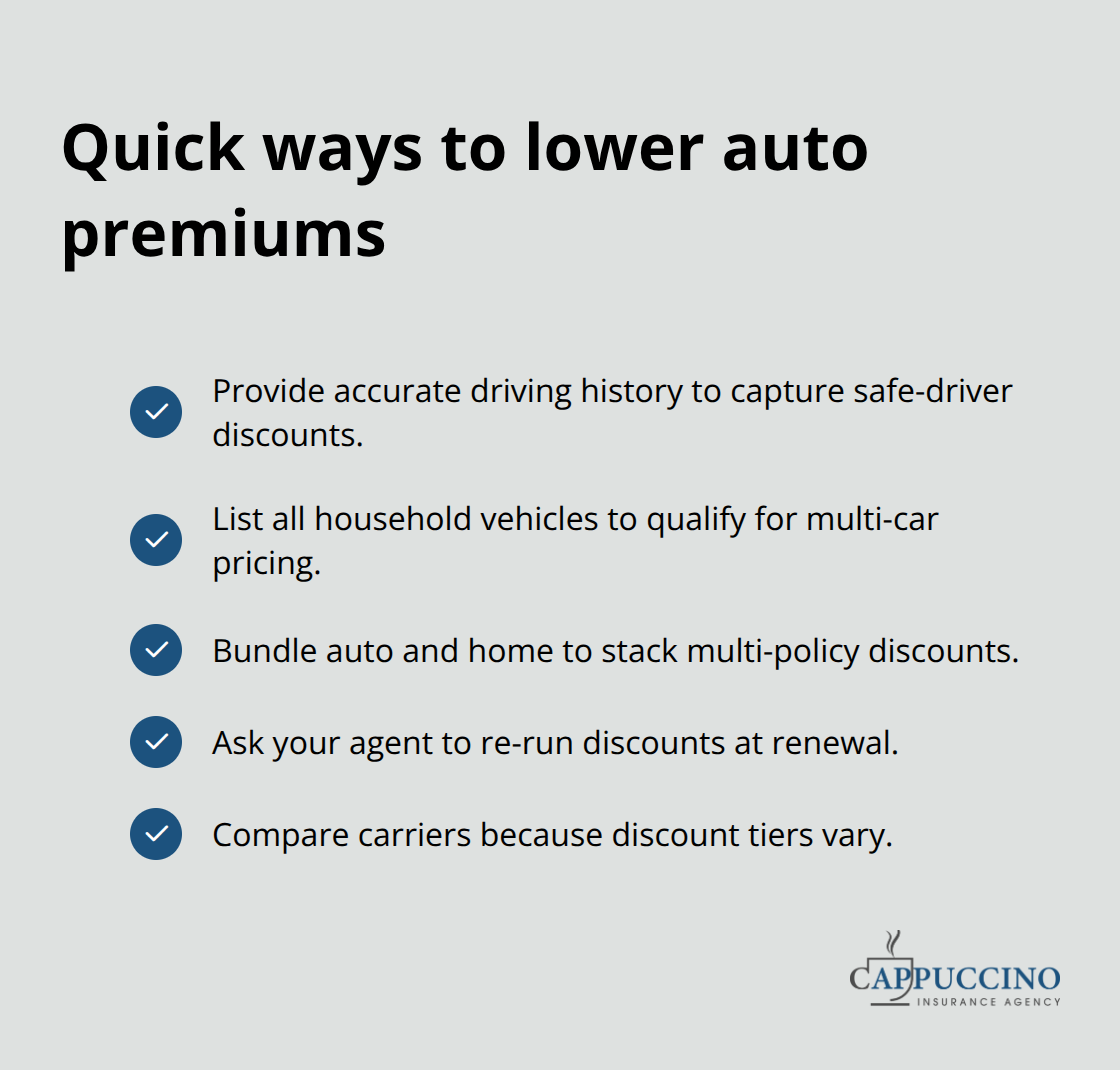
The better strategy involves obtaining three separate bundle quotes before committing to any carrier. Compare the total annual cost for both policies combined, not just the auto premium alone. A carrier offering a smaller auto discount but a larger homeowners discount might deliver a lower total cost than the insurer with the headline-grabbing auto bundle percentage. California drivers who skip this comparison step typically overpay by $300 to $600 annually on their combined home and auto premium.

Hub-and-spoke visual of proven tactics to reduce California auto insurance costs.

Set Your Deductible to Match Your Financial Reality

Your deductible is the amount you pay out of pocket before insurance covers the rest of a claim. Raising your deductible from $500 to $1,000 typically cuts your collision and comprehensive premiums by 15% to 30%, according to data from the Insurance Information Institute. The math works only if you can actually afford that higher deductible without financial strain.

If a $1,000 deductible forces you to carry credit card debt or skip other expenses, the premium savings vanish because you’ve created a different financial problem. Calculate your emergency fund balance, then set your deductible to a level you could genuinely pay without disrupting your budget. Many California drivers set deductibles far too high chasing savings, then face genuine hardship when a claim arrives.

Ignore Most Seasonal and Limited-Time Offers

Seasonal and limited-time offers from insurers rarely deliver substantial savings despite the marketing language. Some carriers run promotions offering $50 or $100 discounts for signing up during specific months, but these one-time credits disappear after the first year while your base premium remains unchanged. The only exception involves new-customer discounts from carriers you’ve never used before, which can occasionally reach 10% to 15% off your first policy year.

These discounts matter only if the carrier’s base rates are competitive in your area to begin with. Chasing seasonal promotions while ignoring your overall rate structure is like celebrating a $100 coupon while paying $2,000 more annually than a competitor charges.

Final Thoughts

California drivers waste hundreds of dollars annually by ignoring auto insurance discounts California that directly apply to their situation. Safe driver discounts cut premiums by up to 22%, multi-policy bundling delivers 7% to 25% in savings, and low-mileage programs offer 10% to 30% reductions if you qualify. The gap between what you currently pay and what you could pay with proper discount stacking often reaches $300 to $600 per year.

Identify which discounts match your actual circumstances rather than chasing discounts you don’t qualify for. If you have a clean driving record, claim the safe driver discount immediately. If you own a home or rent an apartment, obtain three separate bundle quotes comparing your current insurer against State Farm and USAA before renewal. Set your deductible to a level you can genuinely afford without financial strain, then ignore seasonal promotions that disappear after year one.

Schedule an annual policy review before your renewal date arrives-your situation changes constantly, and insurers won’t proactively lower your premium when you qualify for new discounts. One 30-minute conversation typically surfaces 2 to 4 missed discounts worth $200 to $400 annually. Contact Cappuccino Insurance Agency to get started with a local agent who understands California’s insurance landscape and can match you with the right coverage at the right price.

The information provided in this blog is for general informational purposes only and does not constitute legal, financial, or insurance advice. Coverage options, terms, and availability may vary. Please consult with a licensed professional for advice specific to your situation. Artificial intelligence may have been used to generate text and images in some blog articles and may contain inaccuracies.
Do I Need To Maintain Insurance On My Boat, Motorcycle Or RV During Winter?

Why You Should Maintain Your Insurance Year Round For Your Boat, RV or Motorcycle in Westlake Village, CAIt is a sad time of year when we have to say goodbye to long warm summer nights and hello to more moderate weather and shorter days. But, the good news is pumpkin lattes are out again.

With fewer boat, motorcycle or road trips in the RV happening in the fall and winter months, many wonder if they need to maintain insurance on these vehicles when they aren’t being driven. There are many different scenarios that warrant keeping these vehicles insured year-round so let’s take a closer look at these.

Weather Related Damages: Weather is especially nasty in the winter months so keeping your boat protected from covered weather-related damages is important. Even when stored, lightning, wind and hail can occur.

Physical Damages: It seems strange that you may be subjected to a property claim when your vehicle is not being used. However, take this simple example: You have a house party and someone wants to sit on your bike. During which, they accidentally knock it over denting your custom painted tank and scratching the paint. Your home insurance will not cover this.

Theft & Vandalism: If someone decides to steal your boat, motorcycle or RV in the winter months, you need coverage to cover the loss. Thefts occur everywhere, so even if in a secured area, vandalism can occur. Unfortunately, thieves don’t mind bad weather.

Fire: If your boat, motorcycle or RV is stored in your home or garage and there is a fire, your home insurance will not pay for damages to your vehicle. Instead, you will need a comprehensive insurance policy to cover these damages.

Financing: If you finance your boat, motorcycle or RV, your lienholder will require you to maintain insurance to protect the investment.

Multi-policy discounts: If you insure your boat, motorcycle or RV with your home or auto insurance company, you may be eligible for multi-policy discounts. By removing your insurance on your vehicle, you will raise the cost of your other policies.

Owning a boat, motorcycle or RV is a great experience for most. Don’t turn the joy of boat, motorcycle or RV ownership into a nightmare by trying to cut your insurance costs in the off-season. Protect your vehicle year-round and enjoy greater discounts on your other insurance products by bundling them together. For a quote on your insurance, give us a call. We represent the best insurance companies and can quote you different coverages, rates and apply for special discounts.

Things You Should Know About a Commercial Auto Insurance Policy

Commercial Auto Insurance Agent Westlake Village, CAWhen many people think of a commercial auto insurance policy, they may think of big vehicles such as semi-trucks, box trucks, garbage trucks, etc. However, there are many variations of vehicles that would qualify for a commercial auto insurance policy.

How to Determine If You Need a Commercial Auto Insurance Policy

If you are using your vehicle or your employer’s vehicle for business purposes, you need a commercial auto insurance policy or endorsement. For instance, many people are working in the gig economy in jobs such as delivering food with your own vehicle or doing rideshare. It is important you have the right insurance coverage. If you do get into an accident where you are making a food delivery and damage your vehicle or someone else’s property, your standard personal car insurance policy will likely not cover you. Contact our agents with any questions you may have.

Here is a quick reference to help you determine if you need a commercial auto insurance policy:

  1. Using your vehicle to carry business equipment
  2. Freight transportation
  3. Towing vehicles
  4. Delivering food or goods (Amazon drivers, food delivery drivers, newspaper delivery)
  5. Using your vehicle to chauffeur people (Uber or Lyft Drivers, taxi service)
  6. Transporting material

How Is A Commercial Auto Insurance Policy Different Than My Personal Auto Insurance?

Since your vehicle is being used for business purposes, there are different risks that need to be insured. Additionally, the rating system used by companies is entirely different than a personal auto policy.  Each commercial policy needs vary, so have a discussion with your agent to discuss your specific policy limits. For business owners with many vehicles to insure, business auto fleet policies are available. Additionally, consider adding a commercial umbrella policy above and beyond your standard commercial auto policy to protect your business from a catastrophic vehicle accident claim.

How Much Does Commercial Auto Insurance Cost?

Just like your personal auto insurance policy, a commercial auto insurance policy is rated on many factors. Here are a few common examples of what could determine your insurance rate.

  • Driving records
  • Driver age
  • Credit history
  • The size & type of your vehicle
  • The number of vehicles you are insuring
  • What you plan to transport

Not Sure What Kind of Coverage You Need for Your Business?

That is where we can help. Our agents can help determine what type of coverage will be the best fit for your specific needs. If you plan to use your vehicle for business and personal purposes, we can help you determine an appropriate type of policy. If you are only looking to cover your vehicle for business use, we can help find you the best rate. We will explain all of your options so you understand your policy. Get a free commercial auto insurance quote by calling or emailing us.

EXCITING NEWS!! Cappuccino Insurance is open for business in ARIZONA, COLORADO, OREGON, NEVADA and WASHINGTON!!

Cappuccino Insurance in California, Nevada, Oregon, Washington, Arizona, Colorado

Cappuccino Insurance is headed over our state’s borders, and we’d like to introduce ourselves to our neighbors in Arizona, Oregon, Colorado, Nevada, and Washington!

Do you have a second home, a vacation home, rental property, additional vehicle or “toys” (boat, motorcycle, jet-ski’s) in any of these states? Do you own a business in these areas? You can stay insured with Cappuccino Insurance and keep the same level of amazing service and coverage benefits that you’ve enjoyed in California! You may also be entitled to additional package discounts as well.

Who do you know in Arizona, Colorado, Oregon, Nevada and Washington who would potentially like to increase their coverage benefits and save on their annual premiums? We consider a referral the highest compliment to our agency and as a thank you, we offer a $25 gas card (or Amazon card) to you for each referral who becomes a client. We look forward to showing them the same level of superior coverage and personal service that we strive to show each of you, everyday.

Contact us to learn more. 

Can you Save 15% on your Auto Insurance?

Everyone wants to save money where they can.

If you have a home, condo or apartment insured with Cappuccino Insurance, you could save on both your auto insurance policy and your existing policies by bundling them together.

What are the benefits of bundling? 

1) Save up to 15% on both your home (condo and/or apartment) insurance and your auto insurance.

2 ) Get the convenience of having all your policies under one agency.

3) In the event that there’s a claim on both policies, there may only be one deductible.

It only takes a few minutes to get a quote.

Call us today to get your free quote and get on the road to saving!


Is a Mudslide Covered under your Home Insurance Policy?

Owning a home in California can raise a lot of insurance concerns: earthquake, fire, and now mudslides.  Are mudslides covered on your home insurance policy?

In short, no.

In our last blog, we covered the topic of flood insurance. At the time, rain forecasts were inconclusive, but by now, it is clear that California is having a wet year.

Many areas hit by fires are at risk for mudslides. The number of Montecito homes destroyed by the mudslides were most recently tallied at 115. At the beginning of December residents among the foothills braced for possible mudslides, as well.

It’s not just that these barren areas lack foliage, but during a fire a chemical process occurs which hardens soil, resulting in a loss of topsoil during rains. How much rain does it take to cause a mudslide? According to a recent LA Times article, “In Southern California’s unburned areas, 10 inches of rainfall during the winter is needed to nearly saturate the ground. After that point, a burst of rain of just one-quarter of an inch an hour can trigger widespread shallow landslides. But in areas that experienced a burn, it only takes an intense rainfall.”

Mudslides are NOT covered by home insurance. Yet you can purchase additional flood insurance.

Those in “high risk areas” or Special Hazard Flood Areas will likely already have flood insurance. But you don’t have to live in a traditional high-risk area to be hit by a flood. According to FEMA, “More than 20 percent of flood claims come from properties outside the high risk flood zone.” This is important to note as “floods are the nation’s most common and costly natural disaster and cause millions of dollars in damage every year.”

Contact Cappuccino Insurance to go over your existing coverage and to learn more about flood insurance.


Flood insurance: Will it be a Wet Year for California?

“Several climate experts,” according to a news report, “are saying they are unsure what this winter will bring” for the state.

While some areas of California were harder hit than others by last year’s storms it doesn’t take a catastrophic amount of water to do significant damage.

Flood is one of the exclusions on a home insurance policy. Because there is a 30 day wait period on flood insurance, you can’t wait until there’s an impending storm to up your policy.  Last year California had record rains and some people were left high and dry (no pun intended).

Flood Insurance Facts

✅ Flood insurance is a separate, additional policy.

✅ Homes in a high risk flood zone can be as inexpensive as a few hundred dollars. (Those in “high risk” areas likely already have flood insurance as the mortgage lender requires it).

✅ Flood insurance includes building (it will repair the damage) and losses.

✅ Although home insurance will cover some types of flooding, it will not cover water that comes from the outside in, which is bad news for owners with sloping yards, clogged drains, or areas that can pool water.

✅ Flood insurance also covers water back up through drains. (This is important because although some home insurance policies do cover “back ups,” up to $5000, you will not have to file a claim through your home insurance).

Contact Cappuccino Insurance for more information on Flood Insurance and other policies for your home, business, and automobiles.

Could you be Guilty of Internet Slander? How to Cover your Assets with a Personal Umbrella

It’s very common  to take to the Internet when you have a negative experience with a business.

But could you be held liable for what you post online?

When one Dallas couple took to social media to fight a business grievance, it ended up costing them 1.08 million in damages.

It all started more than two years ago over a $125 disagreement between the couple and their wedding photographer. According to the lawsuit filed by the photographer, the couple used their social media platforms and the media as a “smear campaign,” to “destroy” her business.

The charges were defamation, disparagement, and civil conspiracy, and on August 2nd, “A Dallas County jury found… that social media posts made by Neely and Andrew Moldovan against photographer Andrea Polito amounted to defamation.”

Yikes.

It’s enough to give us pause about our own online activity, like Yelp reviews and Facebook posts.

A recent analysis on Yelp reviews found that out of the million studied, “12.8 percent were 1-star reviews.” The analysis also revealed that customers “tend to leave reviews based on their own personal feelings about their experience, rather than through an objective analysis.” This could be interpreted to mean that when reviews are based on emotions and subjective experiences rather than hard facts, they’re likely to have inaccuracies.
But can we be held liable for a negative social media post?

It’s very possible.

According to a Slate.com article, “Whether a person makes a defamatory statement on a blog, in a newspaper, or on Twitter or Facebook, he or she can be held legally liable for it.”  Furthermore, even “an email sent to a single person can be libelous.”

There is a distinction between slandering a public or private figure. In regards to public figures, “malice” must be proven, but, “In order to be liable for libel against a private figure, a person must have simply been negligent, which means not acting with a reasonable level of care in making the statement in question.”

Even if our own online behavior is squeaky clean and we’re just posting family photos and funny cat videos, we could be held liable for our kid’s online behavior, too.

Your home insurance can include personal injury, and while it’s not standard on most policies, it can be added on and it includes liability. Another option is to have an umbrella policy for this type of liability protection as it covers everything on the under line.

If you have questions about your current policies or you’d like to learn more about adding an umbrella policy to your existing coverage, please contact Cappuccino Insurance.

Hosting on Airbnb? Get Short-Term Vacation Rental Insurance

More homeowners are connecting with sites like Airbnb to rent out a room or their entire house for extra income, but before taking the rental plunge, homeowners need be aware of the risks involved and how their homeowner’s insurance is affected in such enterprises.

Renting on sites like Airbnb can bring potential income but can also come with a whole host of problems. According to one Airbnb host, “There’s one risk that’s even more expensive than vacancy: destruction. If your guest trashes your home, you could (theoretically) lose tens of thousands…”

Horror stories abound, like the story of one Californian women who was left holding the bag for thousands of dollars in legal fees when one guest refused to leave and refused to pay. And according to The New York Times, while Airbnb does come with insurance “for hosts with every stay, the policy has numerous exclusions, and Airbnb requires a host to file a claim within 14 days of a guest’s departure, or before a subsequent guest arrives, whichever is sooner.”

It’s not just damages and potential legal fees that homeowners need to mitigate risks for but liability coverage as well.

Homeowner’s insurance comes with personal liability, which is designated for residential, but by renting the home on Airbnb, the home has become a business. Also a regular home insurance policy won’t cover theft or vandalism caused by renters. Perhaps most poignantly, if the insurer discovers that the home is being rented out on Airbnb or a similar service they may drop the policy and claims might be denied.

To mitigate risks, and not get dropped by their homeowner’s policy, people that are renting their homes out on Airbnb need a special policy: short-term vacation rental insurance. At Cappuccino Insurance, we work with several companies that offer short-term vacation rental insurance. Cost varies by size of home and how much coverage you desire. Please contact us to learn more.


Driving for Uber or Lyft? Learn about Gap Coverage!

Driving for Uber of Lyft? What you need to know about Gap Coverage

If you or someone on your policy is driving for a Transportation Network Company, like Uber or Lyft, you need to know about gap coverage and transportation network endorsement.

Most insurance companies will not issue a policy for personal insurance coverage when they know that driver works for Uber or Lyft. Upon discovering your employment they can cancel and/or not renew the policy, or even worse, deny a claim.

This could be the first issue you run into if you are thinking about driving or are already a driver for a TNC. Almost all personal auto policies exclude livery.

The second important issue in this industry is the gap period. Uber and Lyft provide insurance coverage while the driver has a passenger in the car. But the period while the driver is waiting on passengers or in between passengers has been a point of contention since an Uber driver struck and killed a pedestrian in San Francisco in 2013. Neither the company nor the insurance providers would take responsibility for the claim.

The whole point of having insurance is so you’re covered.

Now there are several companies whom we work with at Cappuccino Insurance that provide both personal car insurance and who will “endorse your policy” for gap coverage.

If you or family members on your policy are driving for Uber or Lyft, talk to your insurance agent to look over any exclusions on your current policy and learn about the best companies for gap coverage. Cappuccino Insurance is here to answer your questions!